
Category Archives: SKYWARN

University demonstrates questionable understanding of tornado warnings

It’s really important that anyone who is in charge of the safety of an institution — a university campus, for example — maintain an updated, working knowledge of how weather warnings work. Tweets sent today by Indiana University today could lead one to believe that its campus safety staff could benefit from some education in that area.

At 1:19 p.m. EST, the Indianapolis office of the National Weather Service (NWS) issued a tornado warning that included a portion of southern Monroe County, Indiana.  The warning came with a polygon that clearly showed that the IU campus was not included.

Polygon associated with Nov. 5 tornado warning near Bloomington, IN. The National Weather Service issued the warning only for the area inside the red polygon.

In addition, the text of the warning indicated that “a severe thunderstorm capable of producing a tornado was located 12 miles northwest of Bedford, moving east at 30 mph.” In other words, the storm was not moving toward Bloomington or the IU campus (which is why NWS meteorologists drew the polygon as they did).

Six minutes after the NWS issued the warning, IU sent a tweet at 1:25 regarding what it called a “tornado warning for Bloomington.”

Cody Kirkpatrick, an IU lecturer in atmospheric science, attempted to clarify IU’s tweet:

The IU Twitter account replied:

Dr. Kirkpatrick knew what he was talking about. Those sending tweets on behalf of IU demonstrated ignorance of the National Weather Service’s “storm-based warning” system. When the NWS implemented that system a decade ago, it replaced the county-wide warnings to which IU’s tweet refers, with warnings based on polygons that indicate where the actual risk is.

In subsequent tweets, Dr. Kirkpatrick attempted to point that out, as well as the fact that IU’s original tweet was ambiguous. IU’s response:

But is warning people who are not at risk really better than warning only people who are truly at risk? Is doing so truly “safe,” or does it exacerbate existing challenges with getting people to respond appropriately to warnings?

The people at any institution like IU, who are in charge of disseminating public safety information, would do well to take full advantage of the informational resources that exist among their own faculty. Doing so could lead to better weather safety communications in the future.

An unexpected honor

2017 Weather-Ready Nation Ambassador of Excellence graphic

I was surprised and honored that this blog was chosen by the northern Indiana office of the National Weather  as a 2017 Weather-Ready Nation Ambassador of Excellence.

If your organization is interested in helping the National Weather Service spread important weather safety messages, check out the WRN Ambassador program.

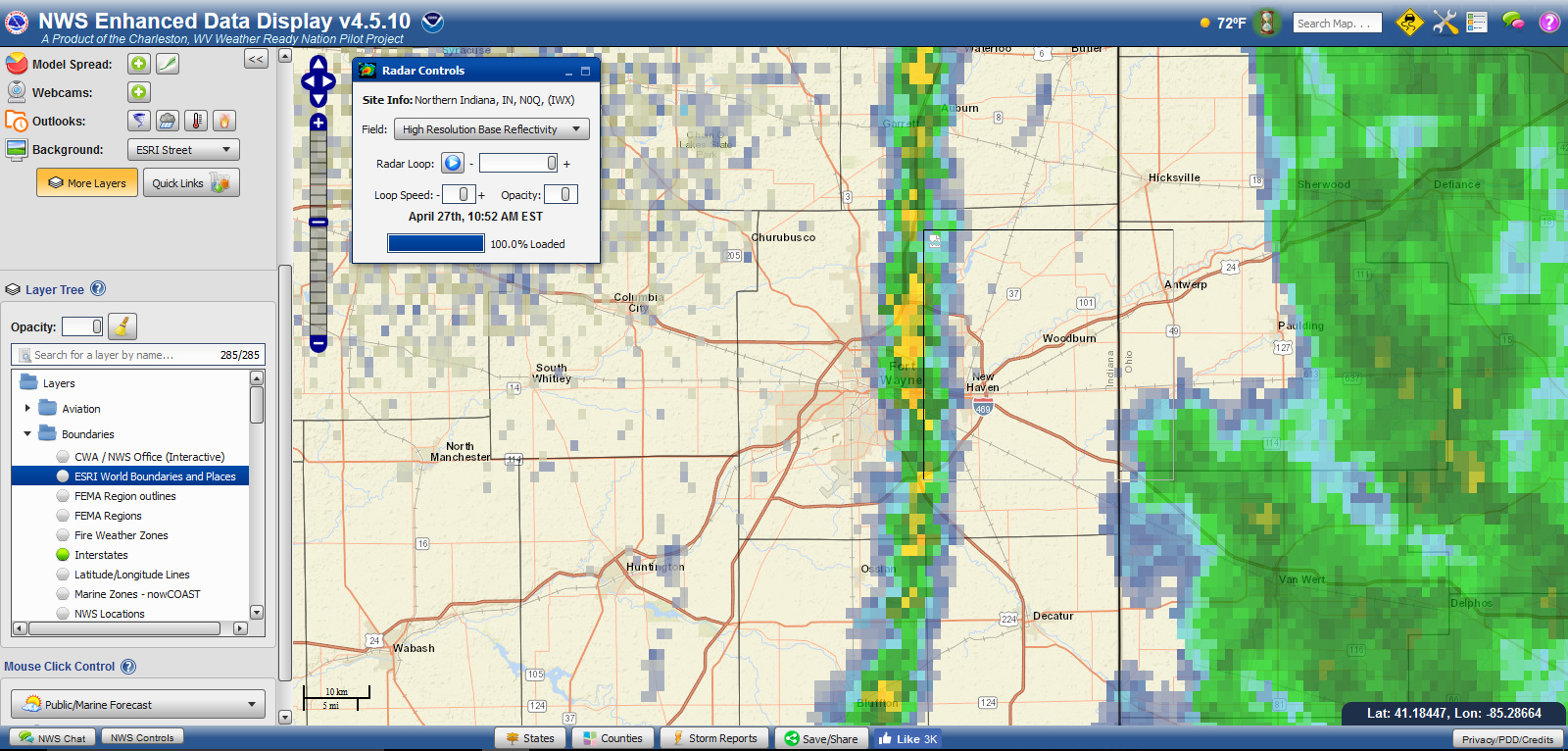
Experimental NWS Enhanced Data Display is useful tool for storm spotters

Example image from National Weather Service experimental Enhanced Data DisplayThe National Weather Service (NWS) is developing a web application that displays radar data and other information on a map. The Enhanced Data Display (EDD) can be a useful tool for SKYWARN storm spotters, especially those who do not have a radar program like Gibson Ridge’s GRLevel3.

EDD can display standard radar base reflectivity data (that common radar image that shows where the rain is and how heavy it is). It can also show velocity products, that show potential rotation in storms.

EDD can also geographically display a large number of NWS products, including convective outlooks, mesoscale discussions, watches and warnings. Once you display any of these products, you can zoom in to specific areas of interest. This can be useful, for example, if you want to learn whether your home is under a level 1 (marginal) or level 2 (slight) risk in a convective outlook, or whether your home is inside or outside a tornado warning polygon.

You can also optionally choose to add layers for features such as county lines, NWS county warning area lines, etc.

You can access EDD at http://preview.weather.gov/edd/. Because the application has so many available features, I highly recommend accessing the online user guide as well, at http://preview.weather.gov/edd/resource/edd/usersguide/EDD_Guide.pdf

Although the application is officially still experimental (which means it might not always work as expected), it’s open to the public and available for you to try. I recommend playing around with it to see how it could help you with your situational awareness.

What residents need to know about their new outdoor warning siren

Tornado siren. Outdoor warning sirens are not intended to be heard indoors.

Blogger’s note: Below is an article I submitted to the “The Waynedale News,” a neighborhood newspaper in Fort Wayne, Indiana. If refers to the installation of an outdoor warning siren in a neighborhood that had been without one for years. The newspaper published the article July 7, 2017.

The new outdoor warning siren that’s coming to Waynedale brings with it some true risks that area residents might not have considered. Chief among those risks are over reliance and desensitization. Continue reading

Fort Wayne hams volunteer to program weather radios

Amatuer (ham) radio operator Steve Haxby, N9MEL, helps a citizen program a weather alert radio
Amateur (ham) radio operator Steve Haxby, N9MEL, helps a citizen program a weather alert radio

Six Fort Wayne amateur radio operators spent several hours May 23 assisting residents with their NOAA Weather Radio (NWR) receivers.

Tom Baker, N9TB; Jay Farlow, W9LW; Steve Haxby, N9MEL; Joseph Lawrence, K9RFZ; Steve Nardin, W9SAN; and Howard Pletcher, N9ADS worked alongside representatives of WANE TV, the Allen County Office of Homeland Security and the National Weather Service at the Walgreens store on Lower Huntington Road to configure NWR receivers.

Volunteers assured that the receivers’ specific area message encoding (SAME) and receive frequency settings were correct, so users would receive warnings that the NWS issues for their home counties.

WANE TV had promoted the three-hour event, which was duplicated at other locations in the TV station’s market area. The Office of Homeland Security estimates that 100 citizens were assisted.

As Joseph put it, the event “was an excellent example of cooperation between local weather personalities, NWS staff, DHS, and amateur radio operators to support our community. Good PR for amateur radio can go a long way in protecting ham radio bands from public utility spectrum grabs.”

Remembering a lesson on a derecho anniversary

An NWS graphic showing the path of the 2012 derecho

Today is the fifth anniversary of a “derecho” thunderstorm that did widespread damage in northern Indiana and locations to the southeast.

“At the peak of the event,” writes the northern Indiana office of the National Weather Service, “the Fort Wayne International Airport observing equipment observed a peak wind gust of 91 mph.”

“Winds were as strong as an EF-1 tornado over a widespread area,” the NWS web page continues, “which resulted in immense damage along the storm’s entire path.” (Emphasis added by W9LW.)

One of the best lessons of that storm should be that we can have massive damage without a tornado. This was a particularly dangerous severe thunderstorm, but there’s no such thing as a “particularly dangerous situation” thunderstorm warning, so we need to pay attention to all severe thunderstorm warnings, even though such warnings are not uncommon.

See an extensive discussion of the 2012 derecho on the NWS northern Indiana website: https://www.weather.gov/iwx/20120629_derecho

“It’s all about the updraft”

College of DuPage meteorology professor Dr. Paul Sirvatka presents at the DuPage County Severe Weather Seminar, March 11, 2017

The title of this post is one of the main points of a presentation I heard at the DuPage County (Ill.) Severe Weather Seminar March 11. College of DuPage meteorology professor Paul Sirvatka reminded spotters that the key to spotting a tornado in a classic supercell is knowing where the updraft is. As Dr. Sirvatka put it, a tornado is a “big sucky thing” that forms under an updraft.

Unfortunately, updrafts are not always easy to find. Depending on your location, important storm features can be obscured, making spotting difficult. And the closer you get to a storm, the more difficult it becomes to identify the important features.

Continue reading

135 Attend Ft. Wayne SKYWARN storm spotter training

135 people attend SKYWARN storm spotter training presented Feb. 21, 2017 by meteorologists from the Northern Indiana National Weather Service office at the Public Safety Academy in Fort Wayne, Indiana.

This is a “reprint” of an article I submitted to the March issue of Allen County HamNews, the monthly newsletter of all three Fort Wayne-based ham radio clubs.

An unusually large crowd of 135 people attended SKYWARN storm spotter training at the Public Safety Academy on the south side of Fort Wayne Feb. 21. That compares to 87 in 2016 and 91 in 2015.

This year’s presentation included video and images from the Aug. 24, 2016 tornado outbreak. Some interesting tidbits from the presentation included:

Continue reading

Top 5 ways to get severe weather warnings

(Updated March 31, 2025)

It’s hard to protect yourself and your family from tornados, damaging straight-line severe thunderstorm winds, or large hail, if you don’t know that the National Weather Service has issued a tornado or severe thunderstorm warning for your location.

So, here’s my list of the best ways to get tornado, severe thunderstorm and flash flood warnings.

Continue reading

A chat with the creator of the weather podcast genre

For 11 years, Alabama broadcast meteorologist James Spann (ABC 33/40, Birmingham) and several of his friends in the weather enterprise have produced a weekly podcast (internet talk show) called WeatherBrains. It was the first in what has become a group of weather-related podcasts that are jointly celebrating the first-annual National Weather Podcast Month in March.

The weather brains normally record WeatherBrains on Monday evenings. Audience members can watch the discussion live on YouTube, watch it later on YouTube or download the program as an audio recording for listening at their convenience.

W9LW’s Ramblings had chance to talk to Spann about the show that started the weather podcast genre and now has an audience in the tens of thousands. Watch the 14-minute interview on YouTube or read it below. The transcript includes a few helpful notes and hyperlinks.

W9LW’s Ramblings: What prompted you to get into the podcast business? Continue reading